Grade 304 vs Grade 316 — Which Should You Choose?
- Share
- publisher
- Yilia
- Issue Time
- May 8,2026
Summary
Grade 304 vs Grade 316 — Which Should You Choose?
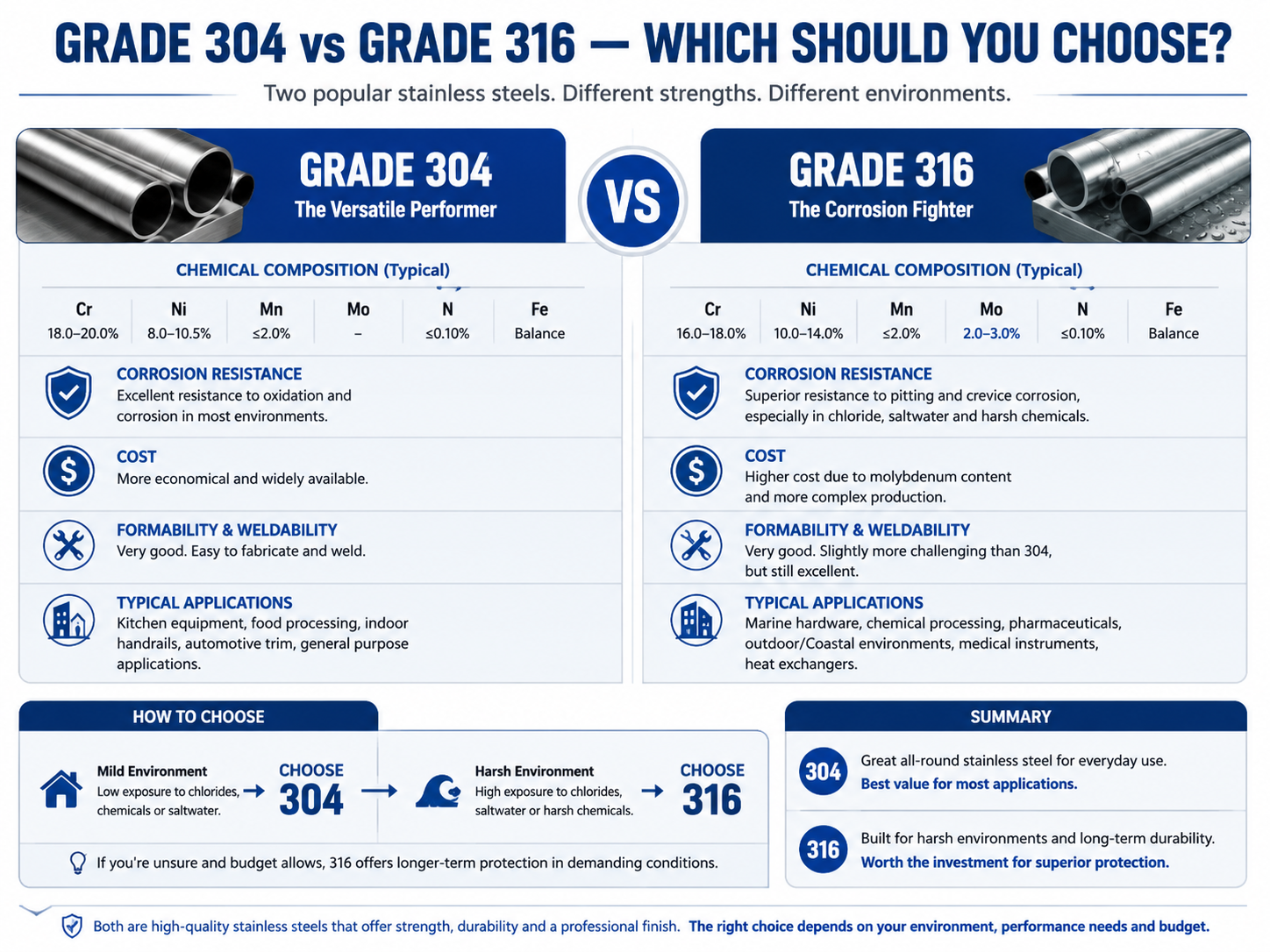
The most common grade selection question for stainless steel buyers is whether to specify Grade 304 or Grade 316. The decision depends primarily on the chloride content, temperature, and chemical exposure of the end-use environment.
Factor | Grade 304 | Grade 316 / 316L | Guidance |
|---|---|---|---|
Mo content | None | 2 – 3% molybdenum | Mo dramatically improves pitting resistance in Cl⁻ environments |
PREN index | ~18–20 | ~24–26 | Higher PREN = better pitting resistance; 316 is significantly superior |
Chloride resistance | Up to ~200 ppm Cl⁻ at RT | Up to ~1,000 ppm Cl⁻ at RT | Grade 316 required for seawater, brine, or coastal outdoor use |
Price vs 304 | Baseline | +15 to +25% | 304 preferred when chloride exposure is low — better cost efficiency |
Food processing | Suitable — most applications | Preferred — acidic, high-salt | 316 for brine, vinegar, citrus juice, and acidic CIP chemicals |
Architecture (indoor) | Grade 304 — standard choice | Overkill for most indoors | 304 with No.4 or 8K finish for elevators, lobby, furniture |
Architecture (outdoor) | Suitable — urban/suburban | Required — coastal/marine | Within 5 km of coast or salt-air exposure: specify 316 |
Welding thick sections | Use 304L | Use 316L | Low-carbon L grades prevent sensitisation in welded fabrications |
Availability / stock | Excellent — widest range | Good — main grades in stock | 304 has more size/finish combinations available ex-stock |