Steel Profile 2026: Complete Guide to H-Beam, Angle, Channel Types, Standards, and Buying Tips
- Share
- publisher
- MESCO Steel
- Issue Time
- Oct 26,2026
Summary
Steel profile 2026 guide: H-beam, I-beam, angle, channel, and hollow section types, EN/ASTM/JIS standards and grades, market prices, and a B2B specification checklist.
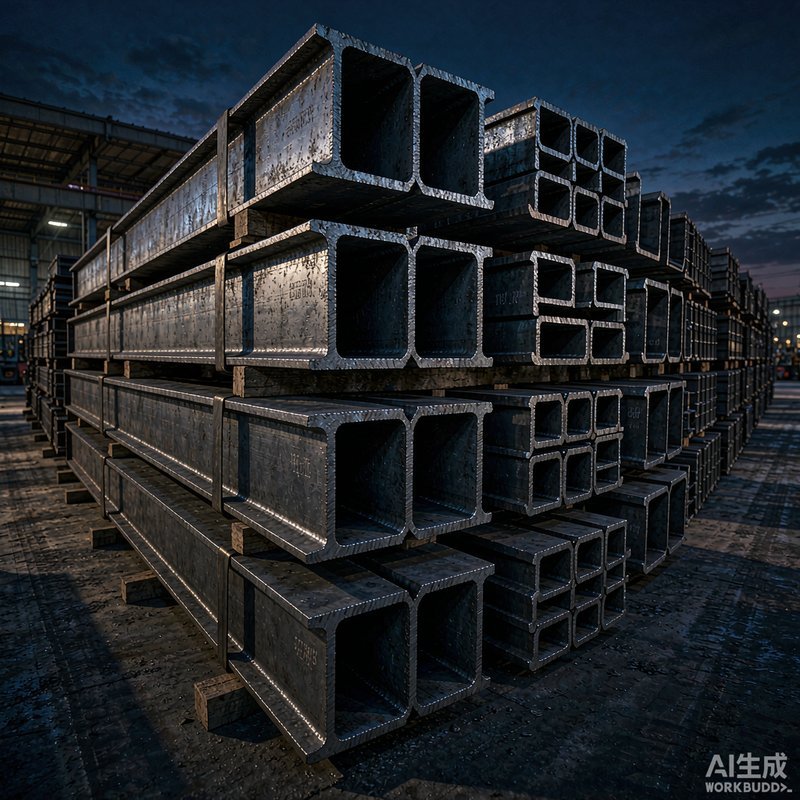
Steel profiles — the structural sections rolled from steel into H-beams, I-beams, angles, channels, and similar shapes — are the skeleton of modern construction and industry. From warehouse frames and bridge girders to transmission towers and data-center structures, steel profiles carry load efficiently because their material is distributed exactly where bending and compression stresses are highest.
Demand has strengthened through 2026: the global structural steel market is estimated at about USD 122.9 billion this year, up from USD 115.8 billion in 2025, and is projected to approach USD 154 billion by 2030 at a compound growth rate of about 6.1%. This guide explains the main types of steel profiles, the standards and grades that govern them, 2026 price trends, and a practical specification checklist for B2B buyers.
What Are Steel Profiles? Main Types of Structural Sections
Steel profiles are produced either by hot rolling — universal mills for H and I beams, angle mills for angles and channels — or, for large or customized sections, by welding steel plates into built-up girders. Each shape performs a distinct structural job, and the correct choice depends on how the member will be loaded: bending, compression, or tension.
| Profile Type | Shape & Characteristic | Typical Use | Common Size Range |
|---|---|---|---|
| H-beam (wide flange) | H cross-section, wide parallel flanges | Columns and beams in building frames | 100–900 mm height |
| I-beam (standard beam) | I cross-section, tapered flanges | Bridge and crane girders | 80–630 mm height |
| Angle (equal / unequal leg) | L-shaped section | Bracing, brackets, trusses, towers | 20–200 mm legs |
| Channel (U / C section) | U-shaped section | Purlins, stringers, light frames | 50–400 mm height |
| Hollow section (SHS / RHS) | Square or rectangular tube | Columns, frames, mechanical parts | 20–500 mm |
Size ranges are typical catalog values for orientation. Final dimensions, section moduli, and unit weights must be confirmed against the relevant standard's dimension tables for the specific grade ordered.
Standards, Steel Grades, and Quality Marks
Most internationally traded steel profiles follow EN 10025 in Europe, ASTM A36 or A992 in North America, or JIS G3101 in Asia. The standard defines the chemical composition, mechanical properties, tolerances, and the mill test certificate (usually EN 10204 3.1) that accompanies the material. Grade selection determines yield strength, impact toughness, and weldability — three properties that cannot be changed after rolling.
| Standard | Typical Grades | Key Properties |
|---|---|---|
| EN 10025-2 | S235JR, S275JR, S355JR / J2 | General structural; good weldability; J2 offers 27 J impact at -20°C |
| ASTM A36 | A36 | General structural carbon steel, about 250 MPa yield |
| ASTM A992 | A992 (W-shapes) | Improved seismic performance, 345–450 MPa yield |
| JIS G3101 | SS400, SM490 | General structure and steel construction |
For structural-grade purchases, traceability matters as much as chemistry: buyers should request ladle analysis, mechanical test results, and full traceability from the mill, and arrange third-party inspection (SGS, Bureau Veritas, or equivalent) when the profile is destined for certified projects.
The most common import mistake is ordering a profile "by name" without a grade and standard. H-beam, angle, and channel dimensions are nearly identical across EN, ASTM, and JIS catalogs — but the mechanical properties differ. Always specify standard + grade + size, for example EN 10025 S355JR H-beam 200x200x8x12.
2026 Steel Profile Market Trends and Prices
Prices have diverged sharply by region in 2026. In the United States, wide-flange (H-beam) prices sat near USD 1,700 per short ton in August 2026, supported by mill maintenance and firm construction demand, while hot-rolled coil traded around USD 1,170–1,200 per short ton. In China, section steel prices traced an N-shaped path through the first half: about RMB 3,352 per ton in January, a May peak near RMB 3,505, and roughly RMB 3,377 by the end of June as supply recovered.
- China's 15th Five-Year Plan calls for grid investment above RMB 5 trillion, driving an estimated demand of about 3 million tons per year of high-strength angle steel for transmission towers.
- Data-center construction has become a new demand pillar: Meta's Mesa, Arizona project alone uses roughly 12,000 tons of structural steel, and Amazon's New Carlisle campus is a USD 15 billion program.
- North American wide-flange supply tightened in 2026 after scheduled mill maintenance, keeping H-beam prices near USD 1,700 per short ton.
- Galvanized profiles and high-strength low-alloy (HSLA) grades are gaining share in outdoor and seismic applications as engineers optimize member sizes.
How to Buy Steel Profiles: A Specification Checklist
- Confirm type and size against a recognized standard and its dimension/weight tables — not against a competitor's catalog.
- Specify the steel grade by yield strength and impact energy: for example S355J2 for cold climates or seismic zones, SS400 for simple framing.
- Request mill test certificates (EN 10204 3.1) and full traceability; arrange third-party inspection for certified projects.
- Consider galvanizing or paint coating for outdoor exposure — hot-dip galvanized profiles last decades on transmission towers and fences.
- Check straightness, length tolerance, and bundle weight for sea freight; agree on how lengths are stacked and lashed.
- Plan lead time: standard H-beams and angles usually ship 2–4 weeks from mill; special sizes or grades need longer confirmation.
Frequently Asked Questions
What is the difference between H-beam and I-beam?
H-beams (wide-flange sections) have wide, parallel flanges and are rolled with an almost square cross-section profile, making them ideal columns and frame beams. I-beams have tapered flanges and a deeper web-to-flange ratio, designed primarily for bending as bridge and crane girders. The two are not interchangeable in structural design, so member sizes must be checked against the engineer's calculation.
Which steel grade should I use for outdoor structures?
For outdoor and cold-climate structures, choose a grade with guaranteed impact toughness, such as S355J2 (27 J at -20°C) in Europe or ASTM A992 in North America. Corrosion protection is then provided by galvanizing, painting, or weathering steel — the grade and the protection system are complementary decisions, not alternatives.
Can steel profiles be galvanized after cutting and drilling?
Yes. Hot-dip galvanizing after fabrication is standard practice for transmission towers, fence posts, and outdoor frames. Be aware that drilling, cutting, and welding before galvanizing leaves clean, wettable edges that form a good zinc layer, whereas pre-galvanized profiles that are later cut expose uncoated edges that must be touched up with zinc-rich paint.
How are steel profile prices quoted — by weight or by piece?
Internationally, steel profiles are quoted per metric ton, with theoretical unit weights taken from the standard's tables. The total cost is tonnage multiplied by the price per ton, plus size extras for non-standard dimensions, plus galvanizing, packing, and freight. Always confirm whether the quotation is based on theoretical weight or actual weighed quantity, and how the settlement weight is determined.
Steel profiles are the backbone of construction and industrial projects, and the 2026 market offers both opportunity and risk: strong structural demand from grids and data centers, tight supply in North America, and more competitive Chinese mill pricing. Procurement success depends on specifying the right type, grade, and standard — and on demanding the certificates and inspection that turn a cheap quote into a safe building.
Explore our structural steel profile product range, read more steel market guides, or contact the MESCO Steel team for H-beam, angle, channel, and custom section quotations with full mill test certificates.