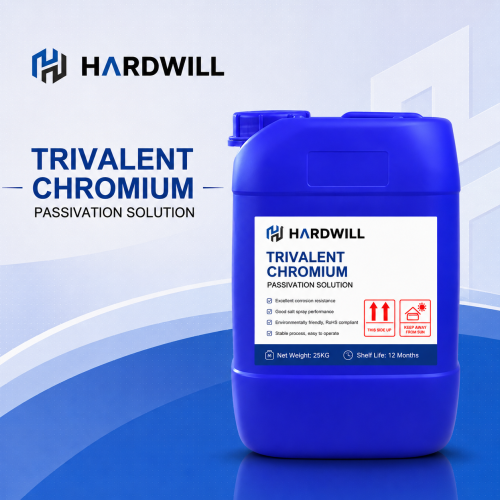
Trivalent Chromium Passivation Solution | HW961 Series | Cr3+ Coating | RoHS Compliant
- Model
- HW-961-1
Review
Description
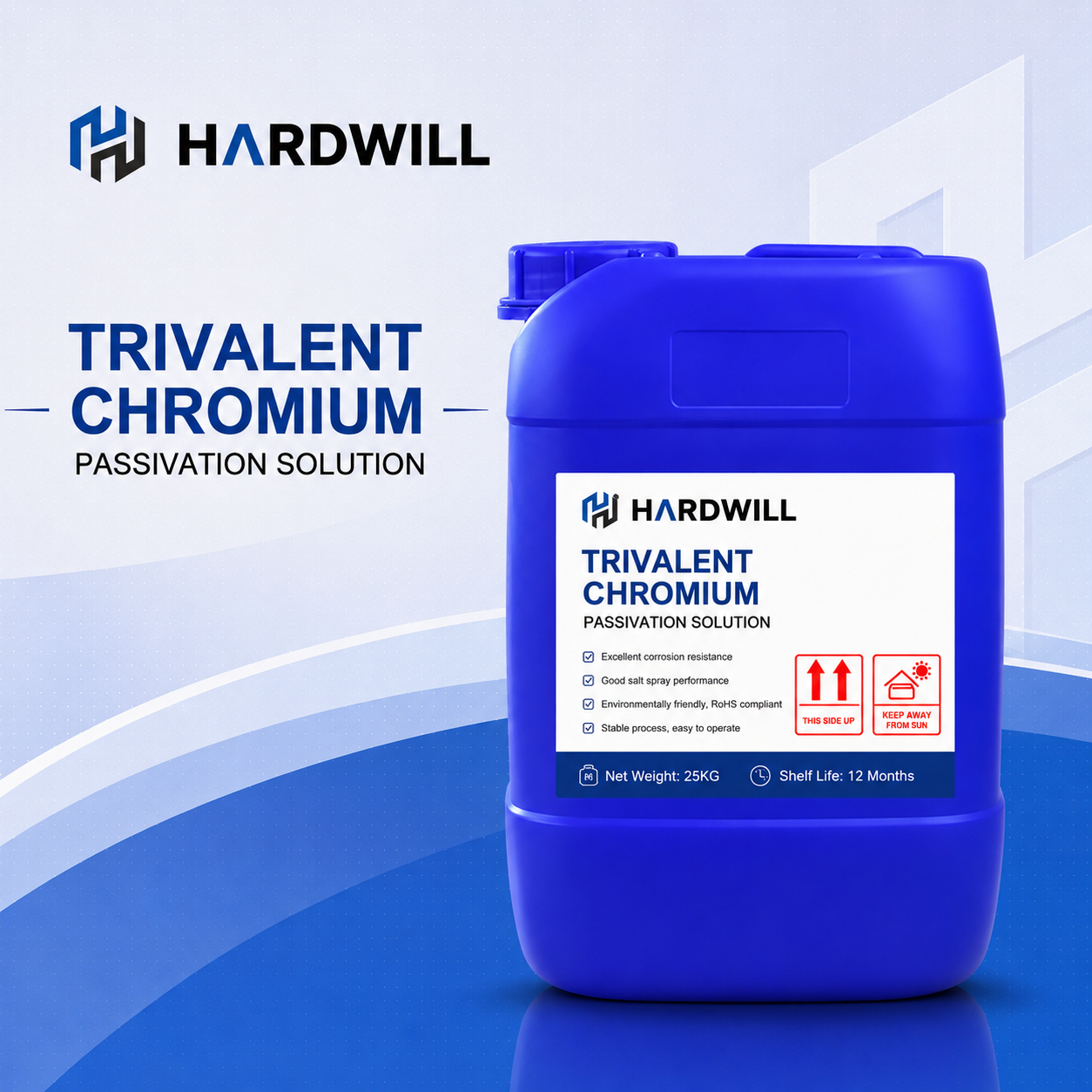
Trivalent chromium passivation is a chemical conversion coating process that deposits a thin, protective film of chromium(III) compounds onto zinc or zinc-alloy electroplated surfaces. Unlike traditional hexavalent chromium (Cr⁶⁺) treatments — which are toxic, carcinogenic, and now banned under EU RoHS and ELV directives — trivalent chromium (Cr³⁺) passivation delivers equivalent or superior corrosion resistance with minimal environmental and health risk.
The HW961 product series represents a next-generation Cr³⁺ passivation solution engineered for industrial precision: consistent film formation, tight pH control, and multi-standard performance including NSS 96h salt spray resistance, high-temperature stability, and chemical resistance to acids, alkalis, and solvents.
| Parameter | HW961-1 (Self-Lubricating) | HW961-2 (Standard) |
| Appearance | Green to dark green solution | Green to dark green solution |
| pH Value | 14 ± 1 | 15 ± 1 |
| Solid Content (%) | < 2 | |
Density | 1.10 ± 0.10 g/cm³ | |
Cr³⁺ Content | 30–50 mg/m² | |
PMT Temperature | 80–120 °C | |
Environmental Compliance | EU RoHS Directive Compliant | |
Storage Temperature | 0–40 °C | |
Shelf Life | 6 months | |
| Comparison Criteria | Trivalent Chromium (Cr³⁺) -- HW961 | Hexavalent Chromium (Cr⁶⁺) -- Legacy |
| Toxicity | Low — safe for operators and environment | High — carcinogenic, regulated/banned in EU/US |
| RoHS / ELV Compliance | Fully compliant | Non-compliant (prohibited) |
| Corrosion Resistance (NSS) | Up to 96h+ | 96–120h (conventional) |
High Temperature Stability | Excellent (240°C × 20 min, ΔE ≤ 3) | Moderate — degrades above 200°C |
Friction Control (Lubricated) | < 0.15 (ZY961-1) | Not available as standard |
Waste Treatment Costs | Low — simple treatment | High — Cr⁶⁺ reduction required before disposal |
Market Trend | Growing — industry standard | Declining — regulatory phase-out globally |
Why is trivalent chromium replacing hexavalent chromium? Hexavalent chromium (Cr⁶⁺) is classified as a human carcinogen (Group 1, IARC) and is restricted or banned under EU RoHS Directive 2011/65/EU, the ELV Directive 2000/53/EC, and REACH Regulation (EC) No. 1907/2006. Trivalent chromium (Cr³⁺) passivation achieves comparable corrosion resistance — typically NSS 48–96+ hours — without the toxicity, waste treatment costs, or regulatory exposure of Cr⁶⁺. The HW961 series is the direct drop-in solution for manufacturers transitioning to Cr³⁺. | ||
| SN | Test Item | est Conditions | Performance Standard |
| 1 | Corrosion Resistance | Flat surface NSS 96h salt spray test | White rust area ≤ 5% |
| 2 | High Temperature Resistance | 240°C × 20 min | Color difference ΔE ≤ 3 |
| 3 | Heat & Humidity Resistance | Open 50°C × 95% RH × 120h | Color difference ΔE ≤ 3 |
4 | Solvent Resistance | 80% alcohol, 50-cycle wipe test | Color difference ΔE ≤ 3 |
5 | Fingerprint Resistance | Vaseline coating for 1 hour | Color difference ΔE ≤ 3 |
6 | Artificial Sweat Resistance | 500ml H₂O + 500ml methanol, 7g NaCl, 1g urea, 4g lactic acid; 20s immersion | Color difference ΔE ≤ 3 |
7 | Alkali Resistance | 40°C, pH 10.5–12.5 alkaline solution, 2 min soak or spray | Color difference ΔE ≤ 3 |
8 | Acid Resistance | 40°C, pH 3.0–4.0 acid solution, 2 min soak or spray | Color difference ΔE ≤ 3 |
9 | Dyne Pen Test | Surface wettability check | ≥ 38# Dyne pen, no shrinkage |
10 | Kinetic Friction Coefficient | Dynamic friction measurement | < 0.15 (self-lubricating advantage) |
| SN | Test Item | est Conditions | Performance Standard |
| 1 | Corrosion Resistance | Flat surface NSS 96h salt spray test | White rust area ≤ 5% |
| 2 | High Temperature Resistance | 240°C × 20 min | Color difference ΔE ≤ 3 |
| 3 | Heat & Humidity Resistance | Open 50°C × 95% RH × 120h | Color difference ΔE ≤ 3 |
4 | Solvent Resistance | 80% alcohol, 50-cycle wipe test | Color difference ΔE ≤ 3 |
5 | Fingerprint Resistance | Vaseline coating for 1 hour | Color difference ΔE ≤ 3 |
6 | Artificial Sweat Resistance | 500ml H₂O + 500ml methanol, 7g NaCl, 1g urea, 4g lactic acid; 20s immersion | Color difference ΔE ≤ 3 |
7 | Alkali Resistance | 40°C, pH 10.5–12.5 alkaline solution, 2 min soak or spray | Color difference ΔE ≤ 3 |
8 | Acid Resistance | 40°C, pH 3.0–4.0 acid solution, 2 min soak or spray | Color difference ΔE ≤ 3 |
9 | Dyne Pen Test | Surface wettability check | ≥ 38# Dyne pen, no shrinkage |