UNS N07718 / Werkstoff 2.4668
Alloy 718 (Inconel 718) Nickel-Chromium Superalloy
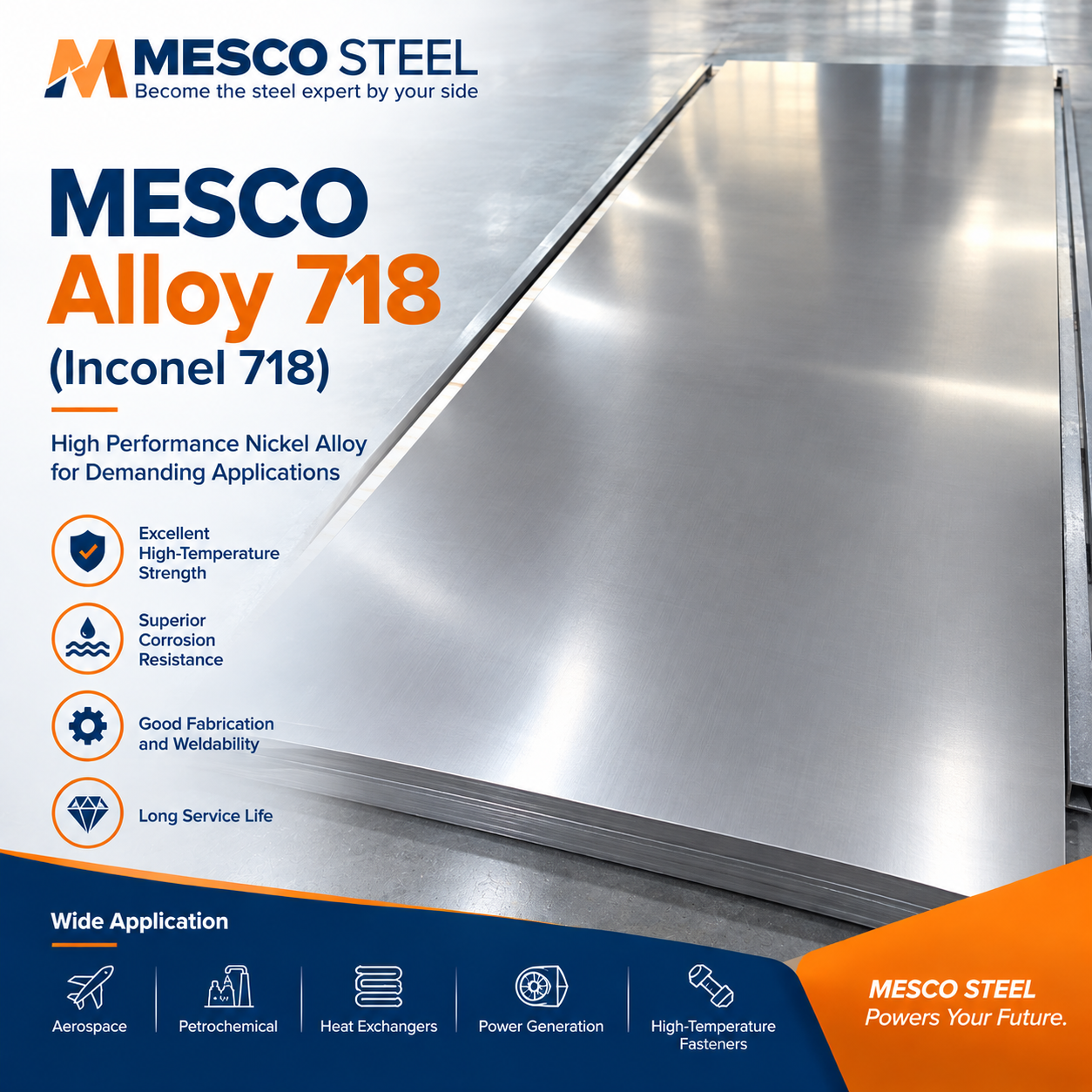
A precipitation-hardening nickel-chromium alloy with niobium, molybdenum, titanium and aluminium. Combines high strength, corrosion resistance and excellent weldability, retaining outstanding stress-rupture strength up to 700 °C. Supplied as pipe, sheet, bar, forging and fasteners by MESCO.
ChemistryNi-Cr-Fe-Nb-Mo
Density8.19 g/cm3
Melting Range1260 - 1336 °C
Service Tempto 700 °C
What Is Alloy 718?
Alloy 718 (Inconel 718, UNS N07718) is a precipitation-hardening nickel-chromium alloy containing significant amounts of iron, niobium and molybdenum with small additions of aluminium and titanium. This composition gives it a unique combination of high strength, corrosion resistance and excellent welding characteristics, including resistance to post-weld cracking.
The alloy is particularly noted for its exceptional stress-rupture strength at elevated temperature — even at 1300 °F (700 °C). Because it keeps its strength and remains readily fabricable and weldable, Alloy 718 is used in gas turbines, rocket propulsion, spacecraft, nuclear reactors and tooling applications.
Key Features
Precipitation-Hardened Strength
Niobium, titanium and aluminium form hardening phases that deliver very high strength in the aged condition.
High-Temperature Strength
Outstanding stress-rupture strength retained at elevated temperature, even up to 1300 °F (700 °C).
Corrosion Resistance
Good resistance to oxidation and to a wide range of corrosive media at high and low temperature.
Excellent Weldability
Readily welded with resistance to post-weld cracking, unlike many other precipitation-hardening alloys.
Full Product Range
Pipe, tube, sheet, plate, bar, wire, forging and fasteners from a single supplier with matching certificates.
Standards Compliant
Produced to ASTM, ASME, SAE AMS and DIN specifications, and to NACE MR-0175 / ISO 15156 for sour service.
Chemical Composition (wt. %)
| Element | Content | Element | Content |
|---|
| Nickel (Ni) | 50.0 - 55.0 | Chromium (Cr) | 17.0 - 21.0 |
| Iron (Fe) | Remainder | Niobium (Nb) | 4.75 - 5.50 |
| Molybdenum (Mo) | 2.80 - 3.30 | Titanium (Ti) | 0.65 - 1.15 |
| Aluminium (Al) | 0.20 - 0.80 | Cobalt (Co) | 1.0 max |
| Carbon (C) | 0.08 max | Manganese (Mn) | 0.35 max |
| Silicon (Si) | 0.35 max | Phosphorus (P) | 0.015 max |
| Sulfur (S) | 0.015 max | Boron (B) | 0.006 max |
| Copper (Cu) | 0.30 max | Co + Ta | If required |
Physical Constants
| Property | Value |
|---|
| Density | 8.19 g/cm3 |
| Melting Range | 1260 - 1336 °C |
Stress-Rupture Strength (1000 h)
| Temperature | Rupture Strength |
|---|
| 1100 °F / 595 °C | 760 MPa |
| 1200 °F / 650 °C | 590 MPa |
| 1300 °F / 705 °C | 370 MPa |
| 1400 °F / 760 °C | 170 MPa |
Standards & Specifications
Designations
- UNS N07718
- Werkstoff Nr. 2.4668
- DIN 17744, 17750 - 17754
- NACE MR-0175 / ISO 15156
ASTM / ASME / SAE
- ASTM B 637, B 670
- ASME SB-637, SB-670
- SAE AMS 5589, 5590, 5596, 5597
- SAE AMS 5662 - 5664
- SAE AMS 5832, 5914, 5950, 5962
Code & International
- ASME Code Cases 1993, 2206, 2222
- ASME N-62, N-208, N-253
- AECMA PR EN 2404, 2405, 2407, 2408
- AECMA PR EN 2952, 2961, 3219, 3666
- ISO 6208, ISO 9723 - 9725
Typical Applications
Gas Turbines
Turbine discs, blades, casings and combustion components for aero and industrial gas turbines.
Rocket Propulsion
Thrust chambers, nozzles and high-temperature propulsion hardware requiring strength and weldability.
Spacecraft
Structural and engine components for spacecraft and launch systems needing high specific strength.
Nuclear & Tooling
Nuclear reactor components and high-temperature tooling, dies and fasteners for demanding service.
High-Temperature & Corrosion Performance
Stress-Rupture Strength
Maintains exceptional stress-rupture strength in the 595 °C to 760 °C range, ideal for hot-section parts.
Oxidation Resistance
Chromium-rich surface provides good oxidation resistance in continuous and cyclic high-temperature service.
Weld Zone Integrity
Resists post-weld cracking, allowing welded fabrications that keep strength and corrosion resistance.
Frequently Asked Questions
What is Alloy 718 used for?
Alloy 718 is used where high strength, corrosion resistance and high-temperature performance are needed together: gas turbines, rocket propulsion, spacecraft, nuclear reactors and high-temperature tooling. It is a standard choice for hot-section and structural components in aerospace.
What is the difference between Alloy 718 and Alloy 625?
Alloy 718 is a precipitation-hardening alloy that gains very high strength through ageing, with excellent weldability. Alloy 625 is a solid-solution strengthened alloy offering excellent corrosion resistance but lower strength. MESCO can advise on the correct grade for your strength, temperature and corrosion requirements.
Which forms and sizes can MESCO supply?
MESCO supplies Alloy 718 as seamless and welded pipe, tube, plate, sheet, round bar, wire, forging and fasteners, produced to ASTM, ASME, SAE AMS and DIN specifications. Send your size list and quantities and we will confirm availability.
Is Alloy 718 suitable for sour service?
Yes. Alloy 718 is compliant with NACE MR-0175 / ISO 15156 for oil and gas service containing hydrogen sulfide, and is widely used for downhole and wellhead components. Full traceability and mill test certificates are provided.
Can MESCO provide mill test certificates and third-party inspection?
Yes. Every shipment includes an EN 10204 3.1 mill test certificate. Third-party inspection such as SGS, BV or TUV can be arranged on request before shipment.
Request a Quote for Alloy 718
Send your specification, size list and quantity to mesco@mescogroup.com.cn. A MESCO engineer will reply with a detailed solution within 6 hours.
- mesco@mescogroup.com.cn
- +86 15134565556
- Dalian, China